Fat tails and black swans
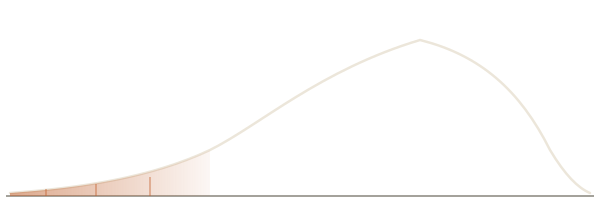
A "tail" is the far edge of a probability distribution — the outcomes that are unlikely but not impossible. In market returns, the left tail is the one that matters most: the handful of days or weeks where losses are severe, fast, and much larger than a normal bell-curve model would predict. Real markets have "fatter" tails than the standard statistical models used to price risk — extreme moves happen more often, and more abruptly, than a clean normal distribution implies.
The popular term for an extreme, hard-to-predict event with outsized consequences is a black swan, coined by Nassim Nicholas Taleb in his 2007 book The Black Swan: The Impact of the Highly Improbable (a second edition followed in 2010). The idea isn't that these events are unforeseeable in principle — it's that they're rare enough, and disruptive enough, that most portfolios and risk models are built as if they won't happen.
Convexity
Convexity describes a payoff that isn't linear — small moves produce small results, but large moves produce disproportionately larger ones. A tail hedge is designed to be convex with respect to market losses: it costs a small, steady amount during ordinary markets, and its payoff accelerates as an equity drawdown deepens. That asymmetry — flat downside cost, geared upside payoff in a crash — is the entire design goal. It's also why a tail hedge is often described as insurance rather than a directional market bet: you pay a premium hoping not to need it, and it pays out precisely when everything else in the portfolio is losing value.
How it's typically implemented
There is no single way to build a tail hedge, but most approaches share a family resemblance. The most common building block is a deep out-of-the-money (OTM) put option on a broad equity index — a contract that is worth little in calm markets but rises sharply in value if the index falls far enough, far enough fast. Some strategies instead (or additionally) use variance swaps or other volatility-linked instruments, which pay out based on how much realized market volatility exceeds what was priced in — a proxy that tends to spike hard exactly when equity markets are falling. Positions are typically rolled systematically — replaced on a schedule as options expire or reach a target — so the hedge stays in place continuously rather than depending on timing any single trade.
How it behaves across regimes
The behavior that defines a tail hedge is its beta — how it tends to move relative to the broad market — and that beta is meant to change shape depending on the environment. In ordinary, rising or range-bound markets, a tail hedge typically carries a small, low positive beta: it costs a little to maintain and mostly just sits there. During a sharp equity drawdown, the same position is designed to flip to a strongly negative beta — rising in value as the market falls, and rising faster the further it falls. That regime-dependent shape, calm-market drag traded for crisis-market convexity, is the trade every tail-hedging strategy is making.